
How to Use the Consumer Protection Act in South Africa
The Consumer Protection Act is your strongest tool as a consumer, but few people use it. Here are your rights and how to enforce them, for free.

How to Use the Consumer Protection Act in South Africa
The Consumer Protection Act is the strongest tool South African consumers have, and most people never use it. It's the law that says you're entitled to goods that work, to honest dealing, and to a way to fight back when a business treats you unfairly. The catch is that rights only help if you know them and use them. This guide explains what the Act gives you, the rights people use most, and exactly how to enforce them, all for free.
Your core rights under the Act
In plain terms, the Consumer Protection Act gives you the right to:
- Quality and safety: goods and services of reasonable quality, that are safe and do what they're meant to do.
- Fair and honest dealing: no misleading claims, no bait-and-switch, no being charged for things you didn't agree to.
- Clear information: prices, terms and conditions in plain language, disclosed upfront, not buried in fine print.
- Fair and reasonable terms: contracts can't contain terms that are unjust or one-sided against you.
- Redress: a real route to a refund, repair, replacement, or compensation when something goes wrong.
The rights people use most
A handful of CPA rights come up again and again in everyday disputes:
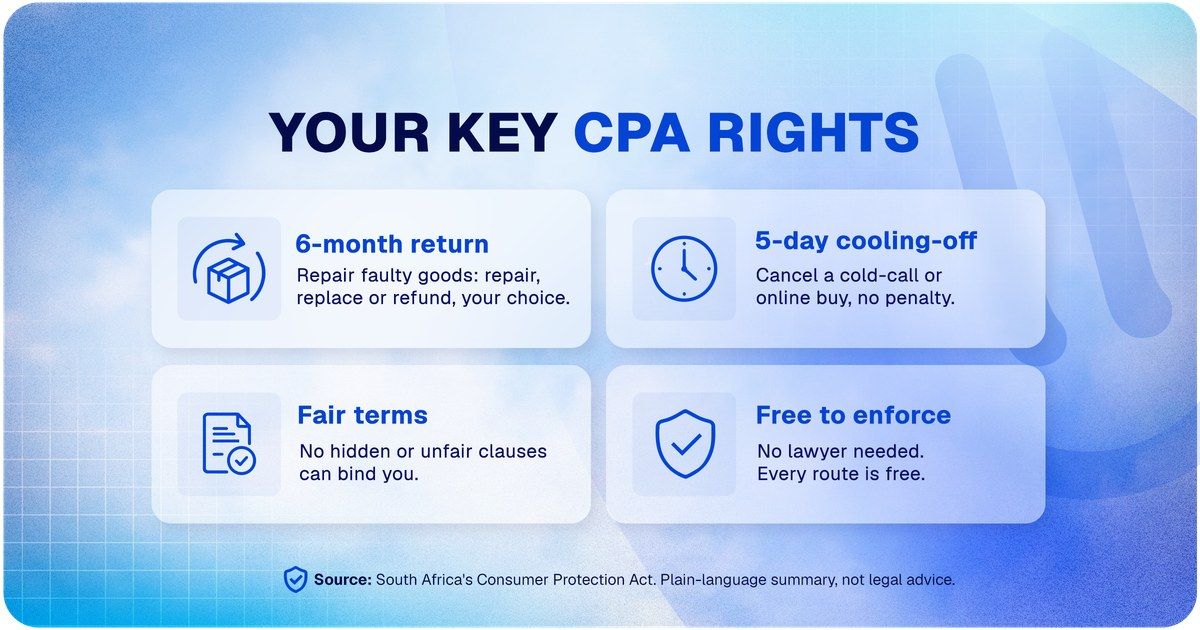
- The six-month return right. If goods are defective, unsafe, or not as described, you can return them within six months of delivery. The Act gives you the choice of a repair, a replacement, or a refund, the shop doesn't get to decide for you, and it can't charge you for the return of genuinely faulty goods.
- The cooling-off period. If you bought something through direct marketing, a cold call, an online or a doorstep sale, you've five business days to cancel without penalty and get your money back. This doesn't apply to ordinary in-store purchases you chose to make.
- Protection from unfair terms. A business can't hold you to a term that's hidden, unfair, or that you were never properly told about. If a clause is unreasonable, it can be challenged.
- No unsolicited goods or charges. You don't have to pay for goods or services you never asked for.
How to actually use the Act
Knowing your rights is step one. Enforcing them follows the same ladder as any complaint:
- Complain to the business in writing, and name your right. Be specific: state what went wrong, what you want (repair, replacement, refund), and that you're exercising your rights under the Consumer Protection Act. Keep the record.
- Put it on the public record. A public, documented complaint on Hellopeter is far harder to ignore than a private email, and it warns the next consumer.
- Escalate to the relevant ombud. Most goods and services fall under the Consumer Goods and Services Ombud; financial products have their own ombud. These are free.
- Lodge with the National Consumer Commission or your provincial consumer affairs office. These bodies enforce the Act, and serious or unresolved matters can be referred to the National Consumer Tribunal.
For the full step-by-step version that works for any company, see our guide on how to complain effectively.
Where the CPA applies (and where it does not)
The Consumer Protection Act covers most transactions between a consumer and a business for goods and services. But some sectors have their own dedicated regulators, and you usually go to them first: financial products and short-term insurance fall under their own ombud schemes, medical schemes fall under the Council for Medical Schemes, and telecoms fall under ICASA. When in doubt, start with the regulator closest to your issue, the CPA and the National Consumer Commission remain the backstop.
A Note on This Guide
Hellopeter is an independent review platform, not an ombud, regulator or legal adviser. We're the impartial space where customers and businesses sort things out in public. This guide is general information to point you in the right direction, and official processes can change, so always confirm the current steps with the body you're escalating to.